
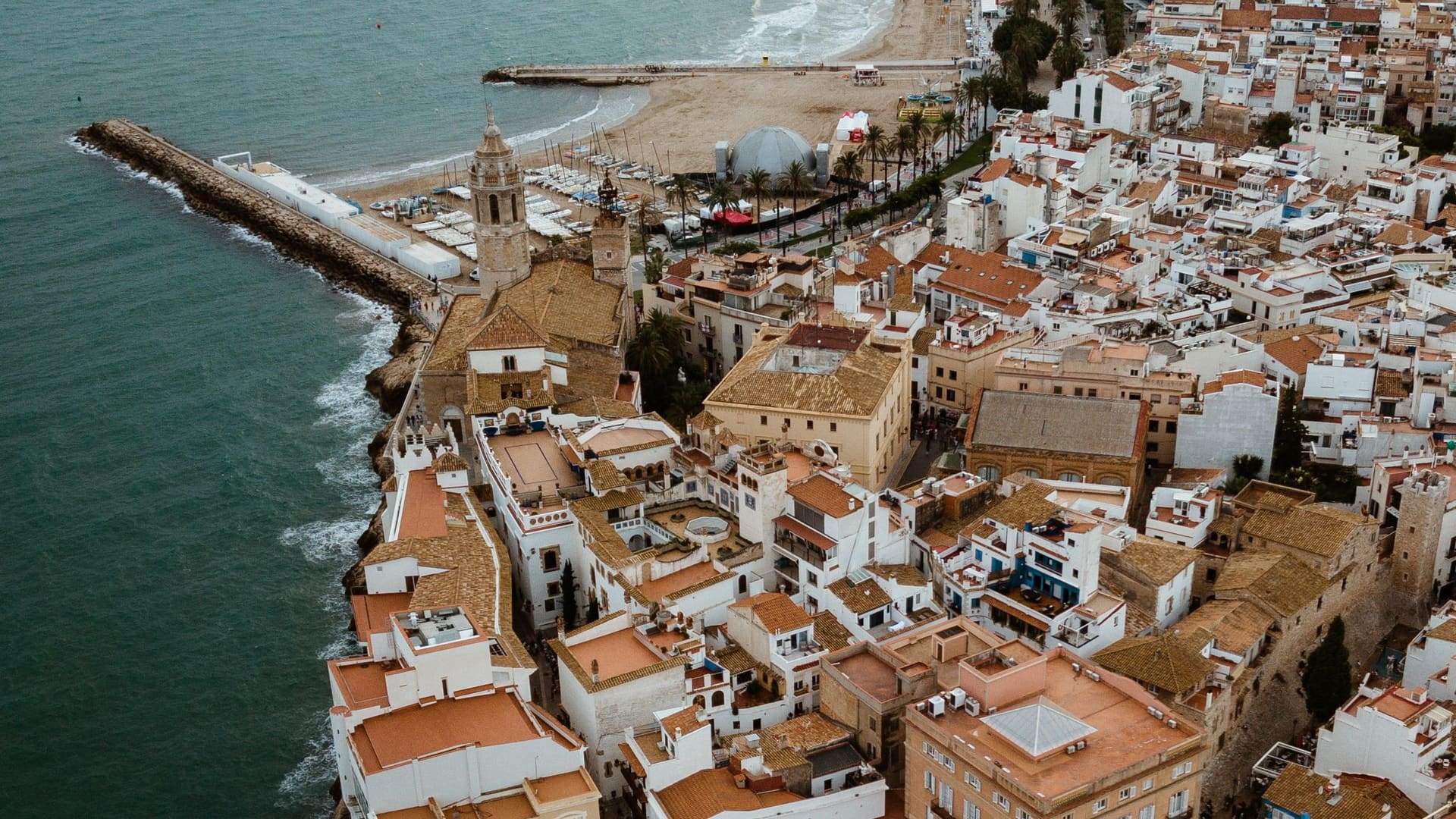
Almost every family who calls us about Sitges arrives with the same two names on their list. Vinyet, because someone told them it is where you walk everywhere. Vallpineda, because someone else told them it is where the British School is.
Both pieces of advice are correct. Neither is the reason to choose one over the other.
These are not two versions of the same neighbourhood at different prices. They are two different propositions: one sells you proximity, the other sells you land. And one of them, for reasons almost nobody mentions at the viewing, is not entirely in Sitges.
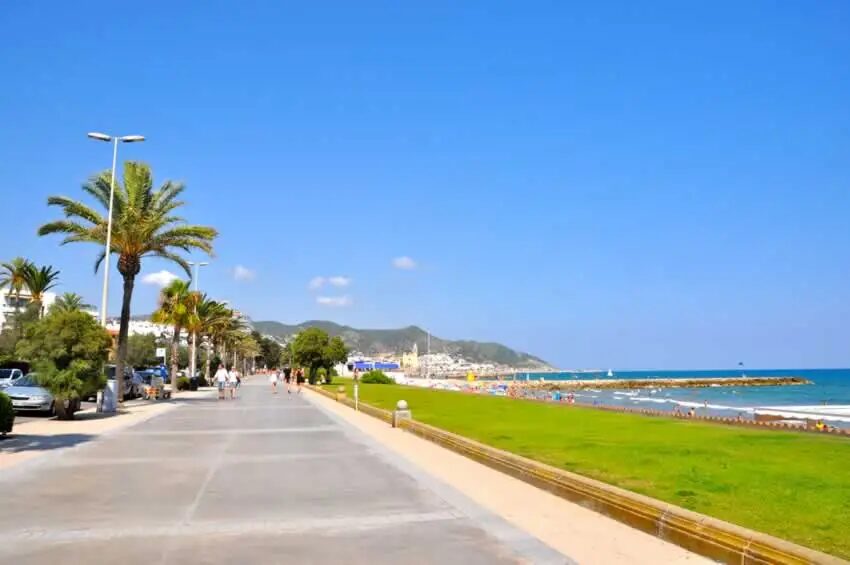
Vinyet: the flat, walkable strip between the seafront and the town.
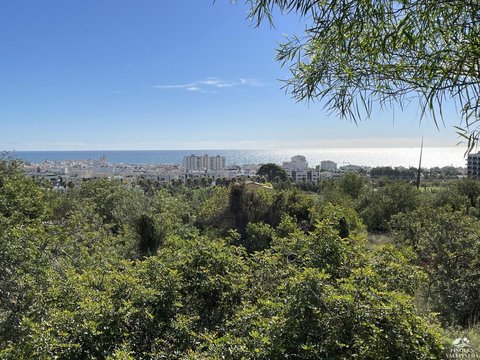
Vallpineda: villas on plots, climbing the hill towards Sant Pere de Ribes.
Where Vinyet and Vallpineda actually begin
Vinyet starts at Avinguda de Sofia. That is the practical line: the seafront walk is called the Passeig de la Ribera in front of the old town, and from Sofia onward it becomes the Passeig Marítim, with Vinyet on the landward side of it. The neighbourhood runs from the sea back towards the Passeig de Vilanova, and it ends, more or less, at the Passeig del Doctor Gaietà Benaprès, where Terramar begins.
It is flat, it is short, and it is the reason people buy there. The station is roughly half a kilometre away, about seven minutes on foot. The centre is a stroll. The sea is across the road.
The name is older than the houses. It comes from the Santuari de la Mare de Déu del Vinyet, a site that was a Roman agricultural villa in the first centuries AD, a documented place of worship from the thirteenth century, enlarged into a church in the first half of the sixteenth (a chapel door dated 1552 is still there), and substantially rebuilt between 1727 and 1733. The residential neighbourhood around it is a twentieth-century thing: it grew out of the Ciutat Jardí de Terramar, the 1919 garden-city project that laid out this whole stretch of coast for the villas and the two hotels of the 1920s, one of which became the Hotel Terramar.
Vallpineda begins where you do: on the right-hand side of the main road into Sitges, and then it climbs. The urbanisation runs up the hill in the direction of Sant Pere de Ribes, and it does not stop at the top. It is younger than Vinyet and it was planned all at once. Construction began in 1963 on land bought by the Barcelona businessman Emilio Adeva; the development pushed into Sitges territory in 1964 after a productive water well was found. The sports club, with its tennis, pool and restaurant, was built to sell the plots and opened in 1966. In 1968 Ricard Bofill built El Castillo there, an apartment building in a development that had been conceived entirely around detached houses.
The developer ran into trouble around 1970, and the residents did something that still shapes the place: in 1970 they formed a service cooperative and took over running it themselves. Water, refuse collection, street maintenance, gardening and repairs inside the urbanisation are still handled that way.
From Vallpineda to Sitges station is about 1.8 kilometres, a little over twenty minutes on foot and about five minutes by car. You can walk it. Most residents, most days, do not.
The line nobody mentions: Vallpineda sits in two municipalities
Vallpineda is not one municipality, and the divide is the hill itself. The top of the hill is the boundary: everything on the Sitges side of the ridge is Vallpineda-Sitges, everything over the crest, falling away towards Sant Pere de Ribes, is Vallpineda-Sant Pere de Ribes. One urbanisation, one set of streets, one cooperative, one club, and two town halls. The larger part of the built area is on the Sant Pere de Ribes side.
This is not local folklore. Spanish population statistics list Vallpineda as a named locality within the municipality of Sant Pere de Ribes, with its own count. The property portals split it the same way, into two separate zones with two separate price series: Vallpineda - Santa Bàrbara filed under Sitges, and Vallpineda - Rocamar filed under Sant Pere de Ribes. And Sitges town hall, in a governing-board decision of 23 December 2024, approved the constitution of a conservation entity for the second phase of the urbanisation of the partial plan covering La Plana, Santa Bàrbara and Vallpineda; that is, Sitges administering its own sector of the urbanisation as a distinct planning unit.
What that means for a buyer is practical, not theoretical, and it shows up in the two places that cost real money.
Tax. Your IBI is billed by whichever municipality your plot falls in, at that municipality’s own rate, on a cadastral value set within that municipality’s own revision. Two comparable houses on the same hill can therefore carry noticeably different annual bills, and the rubbish charge and other municipal fees follow the same line.
Licences. This is the one buyers underestimate. A renovation, an extension, a pool, a new build on a plot: every one of those is a licence granted by your town hall, under its planning ordinances, on its timetable, with its fees. Sitges and Sant Pere de Ribes are two different councils with two different sets of rules and two different queues. If you are buying to renovate, the side of the ridge you are on is not a detail, it is the file your architect will be working to.
The padró follows the same line, and so does the public school zone, a question we always send buyers to ask the relevant town hall directly, because it is set by municipal school zoning and can change.
So the first question on any Vallpineda property is not the price per square metre. It is: which side of the hill is this house on? Ask for the cadastral record and confirm the municipality before you do anything else. It is a thirty-second check that reframes everything that follows.
Vinyet vs Vallpineda: what you are actually buying
| Vinyet | Vallpineda | |
|---|---|---|
| Character | Seafront residential strip, flat, town-adjacent | Villa urbanisation climbing the hill towards Sant Pere de Ribes, private and quiet |
| Stock | Apartments and duplex penthouses, townhouses with gardens, early-twentieth-century seafront villas | Detached villas on plots, some townhouses, a few apartment buildings |
| To the station | About 500 m, roughly 7 minutes on foot | About 1.8 km, roughly 22 minutes on foot, 5 by car |
| Car | Optional | Assumed. Two, usually, once children are at school |
| Outside space | Terraces, courtyards, gardens on the villas | Plots, pools and gardens as standard |
| Municipality | Sitges | Sitges or Sant Pere de Ribes, depending on which side of the hilltop the plot sits |
| Suits | Buyers who want to walk to everything and are content with a terrace | Families who want land, a pool and the school run measured in minutes |
Property prices in Vinyet and Vallpineda, and why to distrust the round numbers
Everything published about either neighbourhood is an asking price. No public index breaks achieved, notarised prices down to this level of detail, because the transaction series stop at the municipality. That gap between what is advertised and what is signed is the single most important thing to hold in mind when reading any of the figures below.
Here is what we see from the desk, in the market as it stands at the end of August 2026:
| Vinyet | Vallpineda | |
|---|---|---|
| Apartments, from | Around €500,000, and typically above it | Around €300,000 for the smaller flats |
| Houses | Up to €10,000,000 at the seafront end | Around €1,000,000 typical, reaching €6,000,000 |
| Long-term rental | From about €2,000 a month, often well above | Houses from roughly €800 a month at the modest end to €3,500 for a villa |
| Our guide, per m² | €6,000/m² | €4,600/m² |
The published indices roughly agree with that shape, and then, in one place, spectacularly do not.
For Vinyet, Fotocasa put the Can Girona - Terramar - Vinyet zone at €6,960/m² in August 2026, which makes it the second most expensive zone in Sitges after Aiguadolç and Sant Sebastià. That is a strong recent number: up 10.2% over three months, but down 2.5% on the year, which is a short spike inside a flat twelve months rather than a trend. Note also that the zone is drawn wider than the neighbourhood, blending Vinyet with Terramar, Can Girona and Can Pei, so it reads slightly rich for Vinyet on its own. As a benchmark, Sitges as a whole sits at €5,662/m² on Fotocasa in August 2026 and €5,312/m² on Idealista in June 2026.
The Vallpineda discrepancy
For what is nominally the same zone, Vallpineda - Santa Bàrbara, Idealista published €3,638/m² in January 2026 and Fotocasa €6,250/m² in August 2026. That is a gap of more than seventy per cent, and the two figures cannot both be describing the same market on a like-for-like basis.
Some of it is the seven months between them. Some of it is almost certainly that the two portals draw the polygon differently, and that an asking-price index for a small zone with few active listings is volatile by construction. The same pattern shows up one level up, where Idealista has Sant Pere de Ribes at €2,472/m² in March 2026 and Fotocasa at €3,035/m² in August 2026, which suggests a methodological difference across the whole area rather than something peculiar to Vallpineda.
We cannot resolve it, so we are not going to pretend to. If someone quotes you a single confident price per square metre for Vallpineda, ask them which portal, which month, and which polygon. In a neighbourhood where plot size, sea view, slope, orientation and municipality all move the number, the average is close to meaningless anyway. Price the house, not the postcode.
International schools, clubs and the daily logistics
The school point is the one buyers most often get half right. The British School of Barcelona campus inside Vallpineda covers Pre-Nursery, Early Years and Primary, ages two to eleven. Secondary and Sixth Form are at the sister campus in Castelldefels. If you are buying in Vallpineda for the school and your children are approaching eleven, the school run changes direction and length in a way worth planning for now rather than discovering later. The Vallpineda campus has an arrangement with the adjoining sports club for its Olympic pool and tennis courts, which is part of why the two feel like one place.
The Centre Esportiu Vallpineda itself, with six tennis courts, four padel courts, two frontons, a pool and a gym, is open to the public, with discounts for members of the cooperative. It is run by a separate company, Fondat S.A., established in 1973, and not by the cooperative that runs the services. Two different organisations, two different bills.
There is a second British-curriculum option in the same municipality: The Olive Tree School, in Sant Pere de Ribes, ages three to sixteen, non-selective, capped at twenty pupils a class. It is not in Vallpineda but it serves the same families, and it covers the secondary years the BSB campus in Vallpineda does not.
In Vinyet the schooling picture is the ordinary Sitges one: the public Institut Vinyet on Carrer Mestre Manuel Torrens handles secondary and one line of batxillerat, and the international schools are a drive away rather than a walk. What Vinyet gives you instead is everything else on foot. The beaches in front of it are the Platja de la Riera Xica, 324 metres of fine sand created in the mid-1970s behind breakwaters, directly opposite the neighbourhood, and the Platja de la Barra, 494 metres long with its four sand-retaining islands, running on towards Terramar. And the promenade, which is the real amenity: the daily walk along the Passeig Marítim is the thing residents there talk about most, and it is the one thing Vallpineda cannot offer at all.
The community and urbanisation charges that only exist in Vallpineda
A flat in Vinyet costs you the normal things: IBI, community fees, utilities.
A house in Vallpineda can carry three layers. The Cooperativa Vallpineda, which supplies water and collects refuse inside the urbanisation and maintains the streets and gardens. The conservation entity that Sitges town hall has been formally constituting for its phase of the sector as recently as December 2024. And, if the property is in a building rather than on its own plot, an ordinary community of owners on top. These are mandatory charges, not optional club subscriptions, and they do not appear on a portal listing.
We could not obtain a current published fee schedule for either the cooperative or the conservation entity, and we are not going to invent one. Ask for the last two years of receipts and the minutes of the last general meeting before you commit. If the seller cannot produce them, that itself is information.
Tourist licences and flood risk: two more things worth knowing
Letting income
Sitges is at its ceiling for tourist-use licences and is not issuing new ones, which matters more in Vinyet than in Vallpineda simply because that is where the short-let demand is. What did change is that the courts struck down part of the local ordinance, so a property that already holds a licence can now be sold with it attached rather than losing it on transfer. If letting income is part of your case for buying, the licence is now an asset to be verified in the purchase, not a permission to be applied for afterwards. We wrote the detail up in the guide to tourist licences in Sitges.
Water
This one falls almost entirely on the Vinyet side, and for the obvious reason: it is flat and it is at sea level. The storms of November 2024 put up to 90 litres per square metre on Sitges, water went through parts of the Terramar area next door, and Avinguda de Sofia was closed to traffic. The riera draining down from Sant Pere de Ribes reaches the sea on that same low ground. Vallpineda, being on a hill, is structurally better placed, but the bottom of the hill, where the urbanisation meets the main road, is not the top of it.
That is a matter of record, not a hazard map. Official flood zoning is published by the Agència Catalana de l’Aigua and it is plot-specific: on anything on the flat seaward ground, or at the foot of the Vallpineda hill, have your lawyer check the property against it before you offer. It is a cheap question and an expensive omission.
So which is the better area of Sitges for you?
People ask where to live in Sitges as though there were one best area. There is not, and anyone who gives you one is selling what they happen to have. Strip away everything else and the choice is about how you want to spend a Tuesday.
Vinyet is for the buyer who wants to walk out of the door, cross to the promenade and do the walk, then come back through the town with the shopping. You will pay a premium per square metre for that, you will mostly be buying an apartment or a terrace rather than a plot, and you will be in the busiest, most sought-after strip of a town that already has more demand than stock. It suits couples, downsizers, people who work in Barcelona and want the train at the end of the street, and families who would rather have the sea than the garden.
Vallpineda is for the buyer who wants land: a plot, a pool, pines, a gate, and the school two minutes away. It buys you more house for the money, it is quiet in a way the seafront never is, and it asks for a car in return. It suits families with young children, people who want to be outdoors on their own ground rather than in public, and buyers who are comfortable with the private-urbanisation structure that comes with it.
Neither is a compromise version of the other. The mistake is to shop them as though they were, comparing a €900,000 apartment in one against a €900,000 villa in the other and concluding that the villa is better value. It is not better value. It is a different life, and one of them is yours.
If you are relocating to Sitges with children and want to see both sides of that choice on the same day, that is an afternoon’s work and we do it most weeks. You can also browse what is currently for sale across Sitges, or read the wider picture in the guide to living in Sitges.
Before you offer on a house in Vinyet or Vallpineda
- In Vallpineda, confirm the municipality from the cadastral record before anything else. The hilltop is the boundary: Sitges on one side, Sant Pere de Ribes on the other, with different IBI rates and different planning departments. If you intend to renovate, build or add a pool, establish which council issues the licence, under which ordinances, before you offer.
- Ask for the last two years of cooperative and conservation-entity receipts, plus the minutes of the last general meeting.
- Check the school question against the campus your children will actually be in, not the one at the gate today.
- On anything on the flat seaward ground, or at the foot of the Vallpineda hill, have the plot checked against the official flood zoning.
- If letting income matters, verify whether a tourist licence exists and transfers. New ones are not being granted.
- Line up the surface figures on the nota simple, the cadastre and the listing before you talk about price. They often disagree.
- Ignore the neighbourhood average per square metre. Ask instead what comparable houses on comparable plots actually sold for.
September is when this market restocks, because families decide over August and instruct in the first weeks of term, so if you are choosing between these two, the next few weeks will show you more of both than the whole summer did.
The neighbourhood pages have the detail on each: Vinyet and Vallpineda, and the wider comparison sits in the guide to the best neighbourhoods in Sitges for families. If you are still at the stage of deciding what to buy rather than where, the guides to houses for sale in Sitges and apartments for sale in Sitges cover the stock in both, and there is a separate one on international schools near Sitges.
Vinyet and Vallpineda: common questions
Is Vallpineda in Sitges or in Sant Pere de Ribes?
Both, and the top of the hill is the boundary. The Sitges side of the ridge is Vallpineda-Sitges; over the crest, falling towards Sant Pere de Ribes, is Vallpineda-Sant Pere de Ribes. It is one urbanisation with two town halls, and the larger part of the built area is on the Sant Pere de Ribes side. Which side you are on decides who bills your IBI and at what rate, where you register on the padró, and which planning department grants your licence to renovate, extend or build. Confirm the municipality from the cadastral record before you offer.
Which is the best area of Sitges for families, Vinyet or Vallpineda?
They suit different families. Vallpineda is the better area of Sitges for families who want land: detached villas on plots with gardens and pools, quiet streets, a private sports club, and the British School of Barcelona campus inside the urbanisation, in exchange for depending on a car. Vinyet is the better area for families who want to walk everywhere: a flat, walkable strip between the Passeig Marítim and the town centre, with Sitges station about seven minutes away on foot, mostly apartments and townhouses rather than plots.
How far is Vallpineda from the centre of Sitges?
About 1.8 kilometres to Sitges train station, a little over twenty minutes on foot and roughly five minutes by car. It is walkable, but most residents drive. Vinyet, by contrast, is about 500 metres from the station, roughly seven minutes on foot.
How much does property cost in Vinyet and Vallpineda?
As asking prices at the end of August 2026: in Vinyet, apartments generally start around €500,000 and seafront houses reach €10,000,000, with long-term rentals from about €2,000 a month. In Vallpineda, smaller apartments start around €300,000 and houses run around €1,000,000 typically, reaching €6,000,000. Our guide figures are €6,000/m² for Vinyet and €4,600/m² for Vallpineda, against a Sitges town average of about €5,987/m². These are asking prices, not achieved sale prices: no public index publishes notarised transaction prices at neighbourhood level.
Does the British School of Barcelona campus in Vallpineda cover secondary school?
No. The BSB campus in Vallpineda covers Pre-Nursery, Early Years and Primary, ages two to eleven. Secondary and Sixth Form are at the sister campus in Castelldefels. A second British-curriculum option, The Olive Tree School in Sant Pere de Ribes, covers ages three to sixteen.
Are there extra community charges in Vallpineda?
Yes, and they are mandatory rather than optional. The Cooperativa Vallpineda, formed by residents in 1970, supplies water, collects refuse inside the urbanisation and maintains streets and gardens; Sitges town hall has been constituting a conservation entity for its phase of the sector; and a property inside a building also has an ordinary community of owners. Ask for two years of receipts and the last general-meeting minutes before committing.
Can you get a tourist licence in Vinyet or Vallpineda?
No new ones. Sitges is at its municipal ceiling for tourist-use licences (HUT) and is not issuing more. What changed is that a property already holding a licence can now be sold with it attached rather than losing it on transfer, so if letting income is part of your case for buying, the existing licence is an asset to verify during the purchase, not a permission to apply for afterwards.
Ronei Kolesny
Correct at 31 August 2026. Price figures are asking prices from portal indices and from our own market observation, not achieved sale prices, and no public index publishes notarised transaction prices at neighbourhood level. Portal zone boundaries do not match neighbourhood boundaries and the two major portals differ materially on Vallpineda; both figures are shown above rather than averaged. Municipal boundaries, community charges, school zoning and flood zoning must be verified for the specific property. This is general information, not legal or tax advice. We always recommend appointing an independent lawyer, and we can introduce one.