
Spain's special impatriate regime — the "Beckham Law", article 93 of the Personal Income Tax Act — lets qualifying newcomers pay a flat 24% on employment income up to €600,000 for the year of arrival plus the five following tax years. It is fully compatible with buying a home in Spain, and it changes how that home is taxed year to year: wealth tax touches Spanish assets only, and no Modelo 720 foreign-asset return is due while the regime lasts. It does not, however, reduce the taxes you pay at purchase.
What the Beckham regime actually is
The "Beckham Law" is the popular name for Spain's special tax regime for workers relocating to Spanish territory, set out in article 93 of the Personal Income Tax Act (Ley 35/2006, IRPF). In force since January 2004 and nicknamed after David Beckham, one of its first high-profile beneficiaries at Real Madrid, it allows a person who becomes tax resident in Spain because of work to be taxed, for most purposes, under non-resident rules for a limited period.
Under the regime, employment income is taxed at a flat 24% up to €600,000 per year, with the excess taxed at 47%. All employment income is caught wherever the work is performed, but most other non-Spanish income — foreign dividends, interest, capital gains and rents — falls outside Spanish taxation entirely. Spanish-source savings income is taxed on a separate scale running from 19% to 30%, the top band applying above €300,000 since 2025. By comparison, an ordinary resident in Catalonia faces progressive IRPF with a top combined marginal rate of 50%.
The regime applies in the tax year you acquire Spanish residency and the five following tax years — up to six years in total. You must opt in using Modelo 149 within six months of registering with Spanish Social Security, and you then file an annual return on Modelo 151. Miss the six-month window and the option is lost.
Who qualifies in 2026
The Startup Law (Ley 28/2022), in force since January 2023, widened the regime considerably. Today it covers employees relocating under a Spanish employment contract or an international posting; remote employees working from Spain for a foreign employer, including holders of Spain's digital nomad visa; directors of Spanish companies, now regardless of their shareholding (unless the company is an asset-holding entity); entrepreneurs pursuing an activity certified as innovative; and highly qualified professionals working for start-ups or in R&D.
Two threshold conditions apply. You must not have been Spanish tax resident in the five tax years before the move — the Startup Law cut this from ten years — and the relocation must be caused by one of the qualifying circumstances. The 2023 reform also allows a spouse and children under 25 to join the regime under certain conditions, which matters for families relocating together.
The exclusions are as important as the inclusions. Ordinary self-employed activity does not qualify — a freelancer invoicing foreign clients from Sitges is generally outside the regime — and income earned through a permanent establishment in Spain is excluded. Professional sportspeople have been expressly barred since 2015; David Beckham himself would not qualify today.
Buying a home while on the regime: what changes and what does not
There is no conflict between the Beckham regime and owning your home. The regime is an income tax election; it places no restriction on acquiring Spanish property, taking out a Spanish mortgage or registering the home as your residence. Many regime beneficiaries buy within their first year or two in Spain.
Equally, the regime does nothing to reduce the cost of buying. Purchase taxes are unaffected by your income tax status. In Catalonia, resale homes have paid a progressive transfer tax (ITP) since 27 June 2025: 10% up to €600,000, 11% from €600,000 to €900,000, 12% from €900,000 to €1,500,000 and 13% above that. A €900,000 resale purchase in Sitges therefore carries ITP of €93,000 — €60,000 on the first tranche plus €33,000 on the second. New-build homes pay 10% VAT plus stamp duty (AJD), generally 1.5% in Catalonia.
One timing point matters more than any other: buying a home neither triggers nor endangers the regime. Your day count in Spain, your qualifying relocation and the six-month Modelo 149 deadline drive eligibility — not the completion date at the notary. Note also that since 3 April 2025 Spain no longer grants residency for property investment; the Golden Visa's real estate route is closed, so your immigration permission and your tax regime are entirely separate questions.
Wealth tax, solidarity tax and Modelo 720 while the regime lasts
While on the regime you are subject to Spanish wealth tax (Impuesto sobre el Patrimonio) by "real obligation" — on Spanish-situs assets only. Your foreign portfolio, foreign property and foreign pensions sit outside the net. The same territorial limit applies to the state solidarity tax on large fortunes (ITSGF), which starts at net Spanish wealth above €3,000,000. For a buyer whose main Spanish asset is the home itself, often with a mortgage secured against it, the practical exposure is frequently modest — though it should be calculated, not assumed.
Just as significant for internationally mobile buyers: no Modelo 720 foreign-asset declaration is due while the regime applies. Ordinary residents must report foreign accounts, securities and property above €50,000 per category; regime taxpayers are exempt from that reporting entirely for the regime's duration.
Your Spanish home does generate income tax consequences. If you let it, the rent is Spanish-source income taxed within the regime, generally at 24% and without resident reliefs such as the long-term rental reduction. If you occupy it, be aware of a live dispute: Spain's central tax tribunal (TEAC) resolved on 17 July 2025 that regime taxpayers must declare imputed income — 1.1% or 2% of cadastral value, taxed at 24% — even on their main residence, a criterion that now binds the tax administration, although the Madrid High Court had ruled the opposite in May 2024 and the question has not yet reached the Supreme Court. Prudent buyers budget for it.
What happens when the regime ends
When the final regime year closes, you become an ordinary IRPF taxpayer: worldwide income at progressive rates, worldwide wealth tax subject to regional rules, and Modelo 720 reporting on foreign assets, first due by 31 March following your first ordinary tax year. For high earners the marginal rate jump — from 24% to as much as 50% in Catalonia — is the headline change, but the reporting shift is what catches people out.
For your home, the transition is broadly favourable. As an ordinary resident your habitual residence generates no imputed income, gains on its sale may qualify for reinvestment relief, and the over-65 exemption can apply later. The main-residence exemption of up to €300,000 also enters the wealth tax calculation.
The sensible sequence is to model the post-regime position during the penultimate year — reviewing where assets are held, whether to restructure before Modelo 720 first applies, and how Catalonia's wealth tax scale affects you — with a Spanish tax adviser. Barleigh Ellis works alongside clients' advisers on the property side of that planning; we do not give tax advice ourselves.
Why Beckham-regime relocators choose Sitges
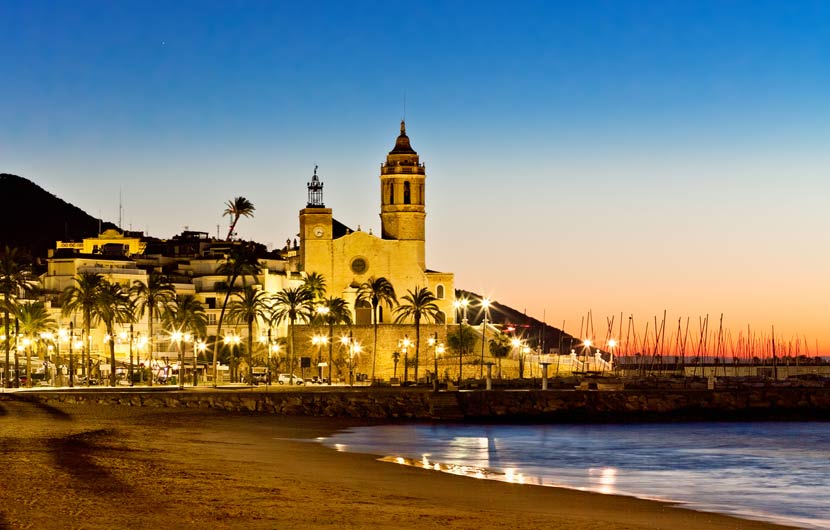
Most regime beneficiaries work in or around Barcelona — as executives, directors or remote employees anchored to a Barcelona-based life. Sitges offers the commute that makes this workable: roughly 35 to 40 minutes by train to Barcelona Sants and about 20 to 25 minutes by car to Barcelona airport, which matters for directors travelling regularly to a foreign head office.
Schooling is the other anchor. The British School of Barcelona operates a Pre-Nursery to Year 6 campus in Sitges itself, with its larger all-through Castelldefels campus a short drive up the coast, and the town has a long-established international community where English is widely used in daily life. For a family arriving on a six-year tax clock, that combination shortens the settling-in period considerably.
The buying pattern we see among regime relocators is a purchase in the €600,000 to €2,000,000 range within the first 18 months, often financed with a Spanish mortgage while foreign assets stay invested abroad — untouched by Spanish wealth tax or Modelo 720 while the regime runs. Barleigh Ellis, registered with API and AICAT, handles the search, negotiation and due diligence side of that move.
| Feature | Under the Beckham regime (2026) |
|---|---|
| Rate on employment income | 24% up to €600,000; 47% above |
| Duration | Year of arrival plus the five following tax years |
| Prior non-residence required | 5 years (cut from 10 by the 2023 Startup Law) |
| Wealth tax and solidarity tax | Spanish-situs assets only |
| Modelo 720 foreign-asset report | Not required while the regime applies |
| Purchase taxes (ITP, AJD, VAT) | Unchanged — the regime does not alter them |
| Owning your home | Fully compatible; imputed income may apply (TEAC, July 2025) |
Related guides
Becoming a Tax Resident in Spain · The Cost of Buying Property in Sitges · Buying in Sitges from Abroad · Spain Residency After the Golden Visa.
Spotted an error or have a suggestion? Let us know here, we keep this guide up to date.
Frequently asked questions
Can I buy a home in Spain while on the Beckham regime?
Yes. The regime is an income tax election under article 93 of the IRPF Act and places no restriction on owning Spanish property. You can buy your home, finance it with a Spanish mortgage and live in it as your residence without affecting your eligibility. What matters for the regime is your qualifying relocation, your day count and the six-month Modelo 149 application deadline — not the purchase.
Does the Beckham Law reduce the taxes I pay when buying a property?
No. Purchase taxes are identical for regime and non-regime buyers. In Catalonia, resale homes pay progressive ITP since 27 June 2025 — 10% up to €600,000 rising to 13% above €1,500,000 — while new builds pay 10% VAT plus stamp duty (AJD), generally 1.5%. The regime affects your annual income and wealth taxation, not the cost of completion.
Do I need to file Modelo 720 while on the Beckham regime?
No. Taxpayers under the special impatriate regime are exempt from Modelo 720, the declaration of foreign accounts, securities and property above €50,000 per category that ordinary residents must file. The obligation begins once the regime ends and you become an ordinary resident, with the first return due by 31 March following your first ordinary tax year.
Does Spanish wealth tax apply to my foreign assets under the regime?
No. Regime taxpayers are liable by "real obligation", meaning wealth tax and the state solidarity tax on large fortunes (above €3,000,000 net) apply only to assets located in Spain. Foreign portfolios, pensions and property abroad are outside the scope. For many relocators the Spanish home, net of any mortgage, is the main asset actually exposed.
How long does the Beckham regime last and what changes when it ends?
It covers the tax year you become resident plus the five following years — up to six in total. Afterwards you are taxed as an ordinary resident: worldwide income at progressive rates, worldwide wealth tax and Modelo 720 reporting. Treatment of your home improves, though — no imputed income on your habitual residence and possible reinvestment relief when you sell.