
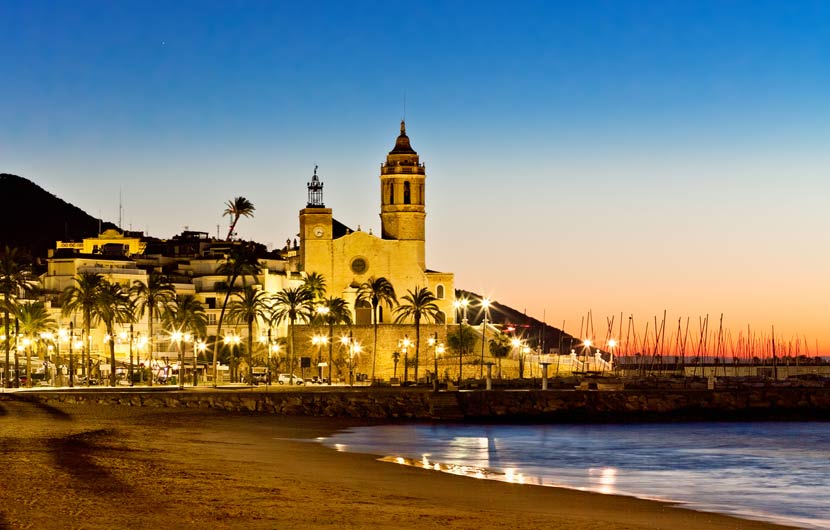
Both are prized coastal towns a short drive from a capital. In short: Sitges is warm-sea Mediterranean living — seventeen beaches, a marina, golf and festivities most weekends, 35 minutes from Barcelona — while Cascais is breezier Atlantic living, with royal heritage, golf and surf, 30 minutes from Lisbon. The decisive change for 2026 is tax: Portugal’s old advantages have largely gone, which re-levels the choice on lifestyle and value — and that is where, in our view, Sitges is hard to beat.
At a glance
| Sitges | Cascais | |
|---|---|---|
| Country & coast | Spain — Mediterranean | Portugal — Atlantic |
| Nearest city | Barcelona (≈ 35 min) | Lisbon (≈ 30 min) |
| Character | Relaxed, walkable, festive, open-minded, family | Elegant, international, golf & surf, royal heritage |
| Typical property | Villas, Modernista townhouses, sea-view homes | Villas, quintas, apartments; prime enclaves |
| Average price/m² | ≈ €5,987 (prime seafront €10,000+) | ≈ €4,654 municipality (prime €6,500–9,000; villas €10,000+) |
| Climate & sea | Warm, dry, calm swimmable sea | Milder, breezier; surf and wind |
| Tax for new arrivals (2026) | Beckham regime: 24% flat possible | NHR gone; IFICI narrow; passive income up to 53% |
| Residency by buying | No (Golden Visa ended 2025) | No (property route closed) |
| Best for | Warm-sea Mediterranean life near Barcelona | Atlantic calm, golf and surf near Lisbon |
Setting & lifestyle
This is the heart of the choice. Sitges is a relaxed seaside town you can live in on foot: seventeen beaches and coves, a marina lined with restaurants, the Terramar golf course, a renowned dining scene and a celebration almost every weekend, all in an open-minded, international and notably welcoming community. Cascais is its elegant Atlantic counterpart — a former royal resort with a pretty marina, a cluster of championship golf courses, the wild Guincho surf beach and the Sintra hills behind it, all within easy reach of Lisbon. Both reward the same buyer: someone who wants a refined coastal town rather than a city. The difference is mood — the warm, festive Mediterranean of Sitges, or the fresh, sporty Atlantic of Cascais.
Property & prices
The two markets meet at the top. Sitges is a market of villas, Modernista townhouses and sea-view homes in enclaves such as Terramar and La Levantina, averaging around €5,987/m² and passing €10,000/m² for prime seafront. Cascais is Portugal’s second most expensive municipality after Lisbon, averaging around €4,654/m² overall but rising sharply in its prime pockets — Quinta da Marinha and the historic centre run roughly €6,500–€9,000/m², with bespoke villas crossing €10,000/m². In other words, the ceilings are similar; Sitges is dearer on a simple average, while Cascais offers a slightly wider spread below the prime tier. For detail on what you actually pay to buy in Spain, see our cost-of-buying guide.
Climate & the coast
For many buyers this decides it. Sitges enjoys a warm, dry Mediterranean climate with calm, swimmable water and dependable summer heat — the classic beach-town rhythm. Cascais has a milder Atlantic climate: cooler, breezier summers that are wonderful for golf and surf but less suited to flat-calm beach days, and the Guincho stretch is famously windy. If your image of coastal life is a warm, gentle sea and long Mediterranean evenings, Sitges delivers it more reliably; if you prefer fresh Atlantic air, dramatic surf and cooler summers, Cascais has real appeal.
Tax & residency in 2026 — the rules that changed
This is the section that has shifted most. For years, international buyers leaned to Portugal for its tax treatment — that case has weakened considerably. Portugal’s Non-Habitual Resident (NHR) regime closed to new applicants and was replaced by IFICI (NHR 2.0), a far narrower scheme aimed at specific high-value professions that no longer shelters pensions or most passive income — now taxed at standard rates up to 53%. Portugal’s Golden Visa also dropped property as a qualifying investment. Spain, for its part, ended its own Golden Visa in April 2025, but still offers the Beckham regime, under which qualifying new arrivals are taxed at a flat 24% on Spanish employment income for up to six years. The headline: neither country is the automatic tax haven it once was, and Portugal’s former edge for retirees and passive-income buyers has largely gone — which puts the decision back where it belongs, on lifestyle, climate and value. None of this is tax advice; model your own position with a qualified adviser, and see our note on Spanish residency after the Golden Visa.
Buying costs & process
Transaction costs are broadly comparable and land in the high single digits. In Catalonia, resale homes carry transfer tax (ITP) of roughly 10–11%, new-builds 10% VAT plus 1.5% stamp duty (AJD), with notary, registry and legal fees on top. In Portugal, the equivalent is IMT (a progressive transfer tax that reaches the high single digits on prime values), plus 0.8% stamp duty and notary and registry costs. Process and timelines are similar — a reservation, a private contract with deposit, then completion before a notary. The bigger practical difference is language and local knowledge: in Sitges and across Catalonia we act for you directly as your buyer’s agent; in Portugal you would want an equivalent local specialist.
Which is right for you?
Choose Cascais if you want cooler Atlantic summers, world-class golf and surf, and Lisbon on your doorstep. Choose Sitges if you want a warm, swimmable Mediterranean sea, a walkable festive town, and Barcelona 35 minutes away — with the 2026 tax changes having removed much of the reason to default to Portugal. For most of our clients weighing the two, Sitges wins on warmth, sea and the sheer ease of a compact town that lives well year-round. It is also where we work every day: as your buyer’s agent we can search, vet and negotiate on your behalf across Sitges and the wider Catalan coast. Start with living in Sitges, or compare it against the city in Sitges vs Barcelona.
Spotted an error or have a suggestion? Let us know here, we keep this guide up to date.
Frequently asked questions
Is Sitges or Cascais more expensive?
They sit at a similar level at the top of their respective markets. Sitges averages around €5,987/m², with prime seafront passing €10,000/m². Cascais averages around €4,654/m² across the municipality, but its prime enclaves — Quinta da Marinha, the Guincho stretch and the historic centre — run €6,500–€9,000/m² and bespoke villas cross €10,000/m². At the end the two are broadly comparable; Sitges is dearer on a simple average.
Is Portugal still tax-friendly in 2026?
Much less than its reputation suggests. The Non-Habitual Resident (NHR) regime closed to new applicants and was replaced by IFICI (NHR 2.0), which is narrow — aimed at specific high-value professions and excluding pensions and most passive income, now taxed at standard rates up to 53%. The Golden Visa also no longer accepts property purchases. Spain ended its Golden Visa in April 2025 too, but still offers the Beckham regime — a flat 24% on Spanish employment income for qualifying new arrivals. Neither country is the automatic tax haven it once was; both need proper modelling.
Which has better weather, Sitges or Cascais?
Sitges has a warmer, drier Mediterranean climate with calm, swimmable sea and more reliable summer heat. Cascais has a milder Atlantic climate — cooler, breezier summers (excellent for golf and surf, less so for flat-calm beach days) and a famously windy stretch at Guincho. If you want classic warm-sea Mediterranean living, Sitges wins; if you prefer fresh Atlantic air and surf, Cascais appeals.
Is Sitges or Cascais better for families?
Both are safe, international and well served by schools. Sitges offers a compact, walkable town with seventeen beaches and the family neighbourhood of Vinyet, 35 minutes from Barcelona’s international schools. Cascais has a strong cluster of international schools and an established expat community near Lisbon. The deciding factors are usually climate, language (Spanish/Catalan vs Portuguese) and which capital you want nearby.
Can I get residency just by buying property in Spain or Portugal?
No. Buying a home does not grant residency in either country since both closed their property-based Golden Visa routes (Spain in April 2025, Portugal earlier). You still need a separate visa to live there — and you generally become tax-resident only by spending more than 183 days a year in the country. Treat the property decision and the residency/visa decision as two separate questions.