
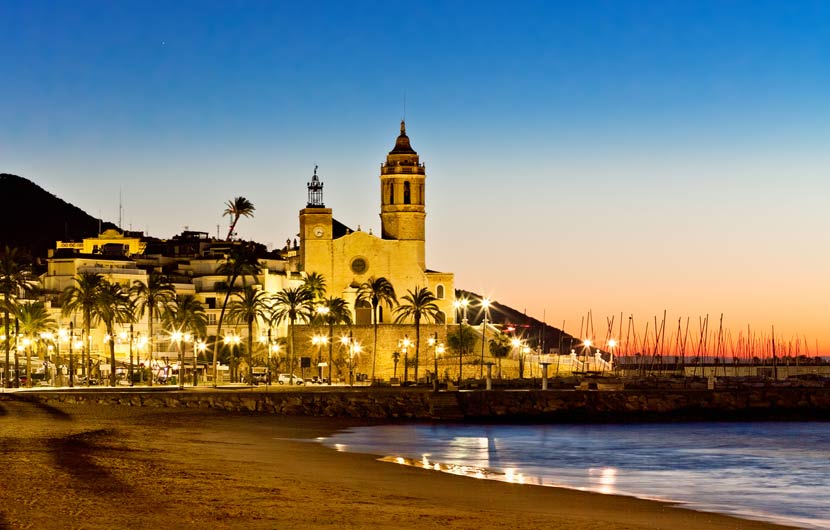
Sitges has long been on the Dutch radar: a little over two hours' flying time from Schiphol, a walkable Mediterranean town with an established international community, and winter light that Amsterdam cannot offer. Buying here from the Netherlands, though, means running two tax systems in parallel — Catalonia's progressive transfer tax and Spain's non-resident taxes on one side, the Dutch Box 3 regime on the other, connected by a treaty signed in 1971 that is still doing the work in 2026. This guide from Barleigh Ellis, a licensed estate agency in Sitges, sets out the full picture, verified against the current rules.
Why Sitges works for Dutch buyers
The practical case first. KLM, Vueling and Transavia all fly nonstop between Amsterdam Schiphol and Barcelona El Prat, with departures spread across every day of the week — KLM and Vueling each operate around 40 weekly rotations in peak season, with Transavia adding more — and a flight time of roughly two and a quarter hours. From the airport, Sitges is around 30 to 35 minutes by car, which makes a Friday-evening arrival at your own front door entirely realistic.
The town itself needs little selling to Dutch buyers, who are already well represented on the Garraf coast. Sitges combines a walkable historic centre, a long seafront and a festival calendar that keeps the town alive through winter, with an international population large enough that English works as an everyday language in shops, schools and professional services. Families are served by the British School of Barcelona's Sitges campus and by further international schools in Castelldefels and Barcelona. And because the Netherlands is an EU member state, you need no visa or permit to buy or to spend time here, and registering as a resident is straightforward if you later relocate. Worth stating plainly all the same: buying property confers no residency status in itself, and Spain's Golden Visa ended on 3 April 2025.
A notario is not a notaris
The biggest process difference catches many Dutch buyers off guard. In the Netherlands, the notaris runs the entire transfer: they investigate title, hold the purchase money in their derdengeldenrekening, execute the deed and register it with the Kadaster. In Spain, the notario authorises the public deed (escritura) and checks identity, capacity and the legality of the transaction — but they do not act for you, do not hold funds in escrow as standard, and do not carry out buyer-protective due diligence. That work belongs to an independent lawyer (abogado) whom you appoint and pay yourself, typically around 1% of the price plus 21% IVA, and who checks title, charges, planning status, community debts and any tourist licence before you commit.
The sequence runs: obtain an NIE (next section), appoint your lawyer, reserve the property (usually €3,000.00 to €10,000.00), then sign the arras contract with a 10% deposit — under a contrato de arras penitenciales, walking away costs you the deposit, while a seller who withdraws must return it doubled. Completion follows at the notary with the escritura, payment of the balance and handover of keys, after which your lawyer settles the taxes and registers the deed at the Registro de la Propiedad. A cash purchase typically takes six to ten weeks from offer to keys; add several weeks if a Spanish mortgage is involved.
Getting your NIE from the Netherlands
You cannot buy property in Spain without an NIE (Número de Identidad de Extranjero), and you will want it early: it is also needed to open a Spanish bank account and to pay the purchase taxes. From the Netherlands, apply in person at the Consulate General of Spain in Amsterdam: book an appointment online, bring the completed EX-15 form, the Modelo 790 fee form and your passport with copies, and expect the number to be issued within a few weeks — timings vary with the consulate's workload, so apply well before you start making offers.
The alternative most Dutch clients use is a power of attorney (poder), signed before the consulate, or before a Dutch notaris and then apostilled. It lets your Spanish lawyer obtain the NIE, open the bank account and even complete at the notary without you flying out for every signature.
Purchase taxes: Catalan ITP against overdrachtsbelasting
For resale property in Catalonia, transfer tax (ITP) has been progressive since 27 June 2025, when Decret llei 5/2025 replaced the flat 10% rate with marginal bands: 10% up to €600,000.00, 11% from €600,000.00 to €900,000.00, 12% from €900,000.00 to €1,500,000.00 and 13% above that. On a €700,000.00 Sitges apartment the bill is €71,000.00, an effective 10.14%. New-build purchases pay 10% IVA plus 1.5% stamp duty (AJD) instead. Add notary, land registry and gestoría fees of roughly 1% to 1.5%, plus your lawyer, and total acquisition costs land between 11% and 14% of the price depending on the band.
The Dutch comparison stings slightly less than it used to. Overdrachtsbelasting on a home that is not your main residence fell from 10.4% to 8% on 1 January 2026, while owner-occupied main homes stay at 2%. A Sitges purchase therefore carries the heavier upfront load — on €700,000.00, €71,000.00 in Catalonia against €56,000.00 for a Dutch second home — but the gap is narrower than the old headline rates suggested, and there is no Dutch equivalent of the annual sun.
Financing and moving the money
Dutch banks will not, as a rule, take Spanish property as security: a Dutch hypotheek must be secured on Dutch real estate. Your realistic options are a Spanish non-resident mortgage — banks here typically lend 60% to 70% of the lower of price and valuation to EU non-residents, over terms of up to 25 years — or releasing equity from your Dutch home, which many buyers prefer for speed and because the debt then sits at home. Take advice on the Box 3 treatment of any loan before settling on a structure, since debts attributable to the Spanish property also fall within the treaty relief calculation.
Moving the money is the easy part. Because the Netherlands and Spain both use the euro and sit inside SEPA, transfers arrive without exchange-rate risk or conversion costs — a genuine advantage over British or Swiss buyers. Expect Spanish anti-money-laundering checks regardless: your lawyer and the bank will ask for documented source of funds, and completion is normally paid by banker's draft or a same-day transfer from a Spanish account.
The big one: Box 3, the 1971 treaty and Spanish taxes
Spain taxes the property first. As a Dutch (EU) resident you pay Spanish non-resident income tax (IRNR) at 19%: on imputed income of 1.1% of the cadastral value (2% where the value has not been revised in the last ten years) for periods of own use or vacancy, and on net rental income — expenses deductible pro rata — for periods actually let, declared annually on Modelo 210. Spanish wealth tax also applies to Spanish net assets above the €700,000.00 state exemption, on a scale of 0.2% to 3.5%, with a state solidarity tax above €3,000,000.00; the option to apply Catalonia's own rules instead (a €500,000.00 threshold) is rarely worth taking.
In the Netherlands, your Sitges home counts among your worldwide assets in Box 3. For 2026 the tax-free allowance is €59,357.00 per person (€118,714.00 for fiscal partners), the deemed return on other assets is 6.00% — the proposed rise to 7.78% was reversed by amendment in November 2025 — and the rate is 36%. The saving grace is the 1971 Netherlands–Spain double taxation convention, which allocates taxing rights over immovable property to Spain: you must still declare the home, but the Netherlands grants a proportional reduction of the Box 3 tax attributable to it (aftrek ter voorkoming van dubbele belasting), effectively exempting it. That 1971 treaty remains in force in 2026: Spain's Council of Ministers only authorised the signing of its replacement on 10 March 2026, signature and ratification by both parliaments are still pending, and the new text does not change where real estate is taxed.
Box 3 itself is in transition. After the Hoge Raad rulings of 6 and 14 June 2024, the tegenbewijsregeling lets you be taxed on actual returns where these are lower than the deemed figure; the replacement Wet werkelijk rendement box 3 passed the Tweede Kamer on 12 February 2026 and is intended to take effect on 1 January 2028, although the Eerste Kamer paused its vote on 30 June 2026 pending government amendments. Under every version on the table, the treaty relief for Spanish real estate carries through.
Renting out: the Sitges licence reality
Plan this before you buy, not after. Sitges appears in the annex of Decret llei 3/2023, Catalonia's list of 262 municipalities where tourist flats (habitatges d'ús turístic, HUTs) are restricted. Any new tourist licence requires a prior municipal urban-planning licence, granted only where local planning expressly allows it and within a ceiling of ten tourist flats per 100 residents, and licences now run for five renewable years rather than indefinitely. In practice, obtaining a new licence in Sitges is difficult and slow, and you should not price a purchase on the assumption of getting one.
Two routes work. Buy a property that already holds a registered HUT number, and have your lawyer verify in due diligence that the registration is valid, transfers with the sale and has been (or can be) converted to the new five-year licence — existing operators must complete that conversion within five years of November 2023. Or let outside the tourist regime altogether: seasonal (temporada) and long-term residential lets need no HUT licence, and as an EU resident you pay 19% IRNR on the net income either way.
| Item | Rate or figure (2026) | Notes for Dutch buyers |
|---|---|---|
| Transfer tax (ITP), resale | 10% to 13% progressive | 10% to €600,000.00; 11% to €900,000.00; 12% to €1,500,000.00; 13% above. In force since 27 June 2025 |
| New build | 10% IVA + 1.5% AJD | Replaces ITP on first transmissions |
| Notary, registry, gestoría | Approx. 1% to 1.5% | Paid at or shortly after completion |
| Independent lawyer | Approx. 1% plus 21% IVA | Does the due diligence a Dutch notaris would; the Spanish notario does not act for you |
| Spanish mortgage (non-resident) | 60% to 70% LTV | Dutch banks do not lend against Spanish collateral |
| IRNR, rental income (EU resident) | 19% on net income | Expenses deductible pro rata; annual Modelo 210 |
| IRNR, imputed income (own use) | 19% of 1.1% (or 2%) of cadastral value | 2% where the cadastral value is unrevised for ten years |
| Spanish wealth tax (non-resident) | Above €700,000.00 net Spanish assets | State scale 0.2% to 3.5%; solidarity tax above €3,000,000.00; Catalan option (€500,000.00 threshold) rarely helps |
| Dutch Box 3 | 6.00% deemed return, taxed at 36% | Declare the home, then treaty relief under the 1971 convention effectively exempts it; allowance €59,357.00 per person |
| Dutch overdrachtsbelasting (comparison) | 8% second homes from 1 January 2026 | Down from 10.4%; owner-occupied main homes remain at 2% |
Related guides
Non-Resident Property Taxes in Spain · Wealth Tax on Property in Catalonia · Getting an NIE to Buy Property in Sitges · Mortgages for Foreign Buyers in Sitges.
Spotted an error or have a suggestion? Let us know here, we keep this guide up to date.
Frequently asked questions
Is the 1971 Netherlands–Spain tax treaty still in force in 2026?
Yes. Spain's Council of Ministers authorised the signing of a replacement convention on 10 March 2026, but it must still be signed and then ratified by both parliaments. Until then the 1971 convention applies, and under both texts real estate remains taxable in the country where it is located.
Do I pay Dutch Box 3 tax on a Sitges holiday home?
You must declare it, but in practice no. Under the 1971 treaty the Netherlands grants a proportional reduction of the Box 3 tax attributable to the Spanish property, effectively exempting it. Spain taxes it instead, through IRNR and, above €700,000.00 of Spanish net assets, wealth tax.
Can I finance a Sitges purchase with a Dutch mortgage?
Not against the Spanish property itself: Dutch banks require Dutch real estate as collateral. Buyers either take a Spanish non-resident mortgage, typically 60% to 70% loan-to-value, or release equity from their Dutch home and complete in cash.
Can I get a tourist rental licence in Sitges?
New licences are heavily restricted. Sitges is on the Decret llei 3/2023 list, so a new tourist flat needs a prior urban-planning licence, capped at ten per 100 residents and valid for five renewable years. The realistic route is buying a property whose existing HUT registration transfers with the sale, verified during due diligence.
How does transfer tax in Sitges compare with the Netherlands?
Catalonia charges progressive ITP on resales: 10% up to €600,000.00, then 11%, 12% and 13% above €600,000.00, €900,000.00 and €1,500,000.00 respectively. The Netherlands charges 8% on second homes since 1 January 2026. On €700,000.00 that is €71,000.00 in Catalonia against €56,000.00 at home.