
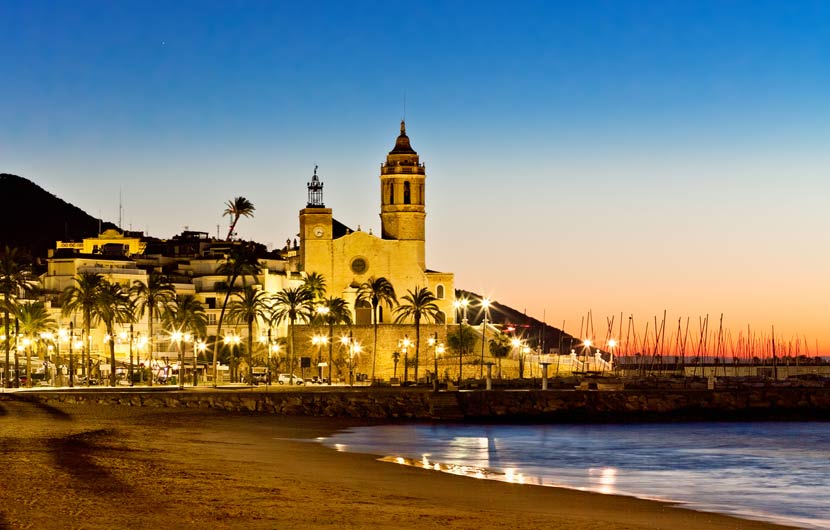
Sitges has been on the German radar for a long time: the Deutsche Schule Barcelona has served the region's German-speaking families since 1894, Lufthansa puts Frankfurt about two hours from Barcelona, and the purchase itself runs entirely in euros, so nothing hangs on an exchange rate. The trap is assuming the process works like a German one. It does not. The Spanish notario will not carry your transaction the way a Notar does, the land registry offers a different kind of protection than the Grundbuch, and Spain will introduce you to a wealth tax Germany stopped levying in 1997. This guide walks through the differences that matter, the 2026 costs in Catalonia, and how the 2011 double taxation agreement treats your Sitges property. Barleigh Ellis is a licensed estate agency in Sitges — API 1190, AICAT 12717.
Why Sitges works from Germany
Start with logistics. Barcelona's El Prat airport is roughly half an hour from Sitges by car, and it connects non-stop to every major German hub: Lufthansa flies Frankfurt in about 2 hours 5 minutes and Munich in about 2 hours 10 minutes, Eurowings serves Düsseldorf, and Vueling, easyJet and Ryanair all cover Berlin, with further direct low-cost links from Hamburg, Cologne and Stuttgart. That density of routes is what makes a second home genuinely usable — a Friday-to-Sunday visit is realistic from any German city, and so is stepping in personally when a tenant, builder or property manager needs you.
For families weighing relocation rather than a holiday home, the Deutsche Schule Barcelona in Esplugues de Llobregat — founded in 1894 and on its current campus since 1977 — teaches more than 1,500 pupils from Kindergarten through to the Abitur, roughly 35 minutes from Sitges along the C-32. Sitges itself is a year-round town rather than a summer resort, with a long-established international community, a sheltered microclimate behind the Garraf hills that keeps winters mild, and schools, healthcare and a working high street that do not close in October. German is not rare here; neither is a neighbour who commutes to Frankfurt on Monday mornings.
The Notar-shaped gap in the Spanish system
In Germany the Notar carries the transaction. A neutral, state-appointed official drafts the purchase contract, checks the Grundbuch, registers the Auflassungsvormerkung that blocks a competing sale, and only lets the money move once the buyer's position is secured. Ownership itself passes on registration — the Grundbuch entry is constitutive. Buyer protection is built into the machinery of the process.
Spain distributes those functions differently. The notario who authorises the escritura de compraventa verifies identity, capacity and the legality of the deed, and requests a same-day extract from the Registro de la Propiedad — but does not investigate planning compliance, outstanding community debts, tenancy status or whether an extension was ever licensed, and does not act for you. Registration in the Registro is declarative rather than constitutive: ownership passes with the deed, and registering protects you against third parties. The due diligence a German buyer expects the Notar to guarantee must instead come from an independent lawyer and a licensed agent. In Catalonia, licensed means an API or AICAT registration you can verify — ask for the number before you rely on anyone's advice.
NIE, power of attorney and the timeline
Every buyer needs an NIE (Número de Identificación de Extranjero) before signing the deed and paying the purchase taxes. From Germany you can apply in person at the Spanish Consulates General in Frankfurt, Munich, Düsseldorf, Hamburg or Stuttgart, or through the consular section in Berlin; allow several weeks for issue. The faster route for most buyers is a power of attorney — signed before a German Notar with an apostille, or at a Spanish consulate — which lets your Spanish lawyer obtain the NIE, open the bank account and even complete the purchase without you flying in.
The transaction itself usually runs: offer, then independent due diligence, then a contrato de arras with a deposit of typically 10%. Under Article 1454 of the Spanish Civil Code the arras bind both sides — walk away and you forfeit the deposit; if the seller walks away, they must return double. Completion follows before the notario, normally eight to twelve weeks after the offer if the NIE is already in hand. The practical advice writes itself: start the NIE before you start viewing.
Purchase costs: Catalonia's progressive ITP
Since 27 June 2025 (Decret llei 5/2025), Catalonia has taxed resale purchases on a progressive scale, like income tax: 10% on the first €600,000.00, 11% from €600,000.00 to €900,000.00, 12% from €900,000.00 to €1,500,000.00 and 13% above that, with a separate 20% rate for large holders. On a €900,000.00 Sitges house the ITP comes to €93,000.00, an effective 10.33%. New-build purchases pay 10% IVA plus stamp duty (AJD) at 1.5% instead. Add notary, land registry and gestoría fees of roughly 1% to 1.5%, and an independent lawyer at around 1%, and total acquisition costs land between 11% and 13% on top of the price.
That is materially heavier than Germany, where Grunderwerbsteuer runs from 3.5% in Bavaria to 6.5% in North Rhine-Westphalia and total costs typically reach 8% to 12% only once the Maklerprovision is counted. One structural consolation: in Spain the seller normally pays the agency fee, so there is no buyer-side commission to split as there has been in Germany since the 2020 reform.
Financing and moving the money
Do not plan around a German mortgage. German banks secure property lending through a charge in the German Grundbuch and will not, in practice, take a Spanish property as collateral; the realistic options are a Spanish mortgage or borrowing against assets you already hold in Germany. Spanish banks lend non-residents 60% to 70% of the bank valuation — residents can reach 80% — over terms of typically 20 to 25 years, so budget a deposit of 30% to 40% plus the 11% to 13% in costs above.
Where German buyers hold a real advantage over British, American or Swiss ones is the currency: the purchase is euro to euro. Funds move by ordinary SEPA transfer with no exchange-rate exposure and no currency broker to appoint. Expect anti-money-laundering checks all the same — the notario and the bank will want documented proof of the origin of funds, so have bank statements and sale or salary records ready before completion week.
Ongoing taxes: IRNR and a wealth tax you have never paid
As EU residents, Germans get the favourable version of Spain's non-resident income tax (IRNR). Rental income is taxed at 19% on a net basis — IBI, community fees, insurance, repairs, mortgage interest and depreciation are deductible in proportion to the days let — where non-EU owners have historically paid 24% on gross income, a distinction the Audiencia Nacional began to dismantle in a ruling of 28 July 2025 that allowed a non-EU owner to deduct expenses. For any period the property sits empty, Spain taxes an imputed income of 1.1% of the cadastral value (2% where the value is outdated), again at 19%, declared on Modelo 210. The town hall adds IBI and a refuse charge each year.
The genuine novelty for a German buyer is the Impuesto sobre el Patrimonio. Germany has not levied its Vermögensteuer since 1997, following the Federal Constitutional Court's ruling of 22 June 1995, so a Sitges purchase may be your first exposure to an annual wealth tax anywhere. Non-residents are assessed only on net Spanish assets: the state allowance is €700,000.00 by default, and you may opt into the Catalan rules, whose allowance is €500,000.00, where the overall result is better. A Spanish mortgage reduces the taxable base, which makes the financing decision part of the tax planning.
The 2011 treaty, capital gains and inheritance
The Germany–Spain double taxation agreement signed on 3 February 2011 — in force since 18 October 2012 and applying from 1 January 2013 — changed mechanics that older guides still describe. Under Article 22(2)(b)(vii), Germany now relieves double taxation on Spanish property income by the credit method, not the old exemption with progression: you declare Sitges rental income in your German return at your personal rate and credit the 19% Spanish tax already paid. The same logic applies on sale. Spain taxes a non-resident's gain at 19%, with the buyer withholding 3% of the price on account via Modelo 211; Germany taxes the gain with a credit if you sell within the ten-year Spekulationsfrist of §23 EStG, and after ten years only the Spanish side remains.
Inheritance is treaty-free territory: Germany's inheritance tax treaties cover Denmark, France, Greece, Sweden, Switzerland and the USA — not Spain. Germany taxes the worldwide estate when the deceased or the heir is German-resident, with allowances of €500,000.00 for a spouse and €400,000.00 per child, while Spain taxes the Spanish property in the heir's hands under Catalan rules, which include a 99% relief for spouses. Relief comes unilaterally through the §21 ErbStG credit. A Spanish will covering the Spanish assets, with a choice of law under the EU Succession Regulation, keeps the two systems from tangling.
| Aspect | Germany | Spain (Catalonia) |
|---|---|---|
| Notary's role | Neutral Notar drafts the contract and steers the whole conveyance | Notario authorises the deed; does not act for the buyer or run due diligence |
| Land register | Grundbuch; entry is constitutive, ownership passes on registration | Registro de la Propiedad; declarative, ownership passes with the deed |
| Buyer protection | Auflassungsvormerkung blocks competing sales before money moves | Independent lawyer plus licensed agent (API/AICAT) carry the due diligence |
| Transfer tax | Grunderwerbsteuer 3.5% to 6.5% depending on the Bundesland | ITP 10% to 13% progressive since 27 June 2025; new builds 10% IVA plus 1.5% AJD |
| Agent's commission | Buyer typically shares it, up to about 3.57% including VAT | Seller normally pays the agency fee |
| Typical total costs | About 8% to 12% on top of the price | About 11% to 13% on top of the price |
| Non-resident financing | Domestic mortgage secured in the Grundbuch | Spanish mortgage at 60% to 70% of valuation, terms of 20 to 25 years |
Related guides
Buying Property in Spain as a Non-Resident · Wealth Tax on Property in Catalonia · Mortgages for Foreign Buyers in Sitges · International Schools in Barcelona.
Spotted an error or have a suggestion? Let us know here, we keep this guide up to date.
Frequently asked questions
Does buying a property in Sitges give me Spanish residency?
No. Spain's Golden Visa ended on 3 April 2025 under Ley Orgánica 1/2025, and no purchase confers residency. As an EU citizen you do not need it: free movement lets you stay, and if you remain beyond 90 days you simply register for the EU citizen's certificate. Spend more than 183 days a year in Spain and you become Spanish tax resident, which changes your tax position entirely.
How is my Sitges rental income taxed in Germany?
Under Article 22(2)(b)(vii) of the 2011 double taxation agreement, Germany applies the credit method to Spanish property income. You pay Spain 19% IRNR on the net rent as an EU resident, then declare the same income in your German return at your personal rate, crediting the Spanish tax paid. The old exemption with progression no longer applies to Spanish rental income.
Can I buy without travelling to Spain?
Yes. A power of attorney signed before a German Notar with an apostille, or at a Spanish consulate, lets your Spanish lawyer obtain your NIE, open a bank account and sign the deed on your behalf. NIE applications can also be made in person at the Spanish Consulates General in Frankfurt, Munich, Düsseldorf, Hamburg or Stuttgart, or through the consular section in Berlin.
Will I pay Spanish wealth tax as a German owner?
Possibly, and it may be your first wealth tax anywhere, since Germany has not levied the Vermögensteuer since 1997. Non-residents are assessed only on net Spanish assets, with a €700,000.00 state allowance by default and the option to apply the Catalan rules with their €500,000.00 allowance. Outstanding mortgage debt on the property reduces the taxable base.
How much will a Spanish bank lend me?
Non-residents typically borrow 60% to 70% of the bank's valuation over 20 to 25 years, against up to 80% for Spanish residents. German banks will not take Spanish property as collateral in practice, so plan on a deposit of 30% to 40% plus roughly 11% to 13% in purchase costs, or borrow against assets you hold in Germany.