
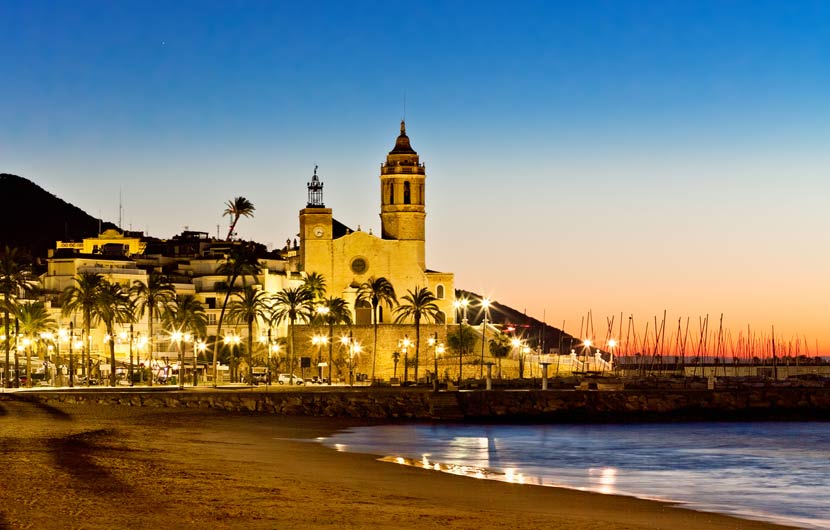
Sitges lies thirty-five kilometres south-west of Barcelona, and for French buyers it is among the easiest foreign markets to reach: a direct TGV from Paris, around two and a half hours on the autoroute from Perpignan, and an established French community with AEFE-network schooling within commuting distance. The legal and tax mechanics, however, differ more than the shared civil-law tradition suggests. A Spanish notario does not do what a French notaire does, the contrato de arras binds harder than a compromis de vente, and a Sitges home remains firmly inside the French IFI net. This guide from Barleigh Ellis, a licensed estate agency in Sitges, sets out what changes once you cross the border.
Getting to Sitges from France
The direct rail link is the headline. SNCF's TGV INOUI runs from Paris Gare de Lyon to Barcelona Sants in around six hours forty minutes, with two departures a day; since the SNCF-Renfe partnership ended in December 2022, SNCF operates the Paris route alone, while Renfe's AVE covers Lyon-Barcelona in around five hours and Marseille-Madrid via Girona and Barcelona. From Sants, the Rodalies R2 Sud train reaches Sitges in about forty minutes. By road, Sitges is roughly 240 kilometres from Perpignan on the AP-7, about two and a half hours, and around four hours from Toulouse. Flying, Paris to Barcelona El Prat takes about one hour fifty minutes with Air France, Vueling, easyJet and Transavia among the operators — and the airport sits on the Sitges side of Barcelona, around twenty-five minutes away via the C-32.
Few foreign communities in Catalonia are as established as the French one. Barcelona has hosted a French consulate, chamber of commerce and cultural institutions for over a century, French nationals are consistently among the city's largest registered foreign groups, and the coastal corridor from Castelldefels through Gavà to Sitges is a familiar landing zone for French families relocating for work in the Barcelona area.
French schooling near Sitges
For families, the schooling question usually decides the move. The Lycée Français de Barcelone is the flagship AEFE establishment in the city, teaching the full French curriculum from maternelle to terminale, and the École Ferdinand de Lesseps, an AEFE-conventioned primary school founded in 1859 and the oldest French school in the Iberian peninsula, covers maternelle to CM2 in central Barcelona. Closer to Sitges, the Lycée International Barcelona Bon Soleil in Gavà, founded in 1969 and an AEFE partner school, teaches around 1,400 pupils from maternelle through to the French baccalauréat, the Bachibac and the International Baccalaureate; from most parts of Sitges the school run is twenty to twenty-five minutes on the C-32. Families preferring English-medium education have further international schools in Castelldefels and Sant Pere de Ribes. In practice, French buyers with school-age children often shortlist Sitges precisely because it pairs a seaside town with a genuine French curriculum within daily reach.
Notario is not notaire: how the process differs
France and Spain share a civil-law, notarised system, which can lull French buyers into assuming equivalence. The difference is scope. A French notaire runs the entire conveyance — title searches, urban planning enquiries, holding funds, drafting — and carries liability for the file. A Spanish notario authenticates the deed (escritura pública), verifies identity and checks the land registry immediately before signing, but does not investigate the property, manage deposits or protect you from a bad bargain. There is no Spanish equivalent of the single-notaire protection, so an independent property lawyer is standard practice; budget around 1% of the price plus IVA.
The preliminary contract also behaves differently. Where a compromis de vente carries the ten-day cooling-off period of the loi SRU, a Spanish contrato de arras — normally signed with a 10% deposit — offers no statutory withdrawal right on a resale purchase. Under the common arras penitenciales of Article 1454 of the Spanish Civil Code, a buyer who walks away forfeits the deposit and a seller who withdraws must return it doubled. The consequence for timing: due diligence happens before you sign the arras, not between compromis and acte. From arras to escritura typically runs four to eight weeks for cash purchases and eight to twelve with a mortgage. You will also need an NIE (foreigner identification number) before completion: the Spanish consulates general in Paris, Lyon and Marseille process form EX-15 with Form 790 (code 012) for a fee of €9.84, usually within about two weeks though busy periods run longer, or your lawyer can obtain one in Spain under a power of attorney.
Paying for it: SEPA transfers and mortgages
Money movement is the simple part. Both countries use the euro, so funds travel by ordinary SEPA transfer with no exchange risk or currency margin. The practical points are anti-money-laundering documentation — your bank and the notario will want the provenance of funds traced — and the completion payment itself, usually made by banker's draft from a Spanish account or through your lawyer's client account.
Financing is less symmetrical. French banks very rarely lend against Spanish collateral, so a French mortgage generally works only if secured on assets you hold in France. Spanish banks lend to non-residents at typically 60% to 70% of the lower of valuation and price, over terms of up to 25 years, assessing the file on your French income against the usual one-third debt-to-income ceiling. Plan on covering 30% to 40% of the price plus all costs from your own funds, and obtain the bank's pre-approval before signing the arras rather than after.
Purchase taxes: Catalonia's progressive ITP
Catalonia reformed its transfer tax with effect from 27 June 2025 (Decret llei 5/2025). Resale property now pays ITP in progressive bands, like income tax: 10% on the first €600,000.00, 11% from €600,000.01 to €900,000.00, 12% from €900,000.01 to €1,500,000.00, and 13% above that. On a €1,000,000.00 resale purchase the ITP comes to €105,000.00, an effective 10.5%. A flat 20% applies to large holders and to purchases of entire residential buildings, with limited exceptions. New-build purchases pay 10% IVA plus 1.5% stamp duty (AJD) instead.
All-in acquisition costs — tax, notary, land registry, legal fees and any valuation — typically land between 10% and 13% of the price, against roughly 7% to 8% frais d'acquisition on an existing property in France. One structural difference works in your favour: in Sitges the selling agent's fee is normally paid by the vendor, not the buyer.
Owning it: IRNR and Spanish wealth tax
As EU residents, French owners get the better side of Spain's non-resident income tax (IRNR). Rental income is taxed at 19% on the net amount, with pro-rata deduction of expenses such as IBI, community fees, insurance, mortgage interest and depreciation; non-EU owners pay 24% on gross income. For any period the property is not let, Spain taxes an imputed income of 1.1% of the cadastral value (2% where the value has not been recently revised), again at 19%, declared annually on Modelo 210.
Spain also levies wealth tax on the Spanish assets of non-residents, who may opt into the rules of the region where those assets sit. For Sitges that means Catalonia: a minimum exemption of €500,000.00 (the €300,000.00 habitual-residence allowance does not apply to a non-resident's second home) and a scale running from 0.21% to 2.75%, with a 3.48% band on taxable bases above €20,000,000.00. Acquisition debt secured on the property is deductible, which is one reason many French buyers keep a Spanish mortgage in place. On a future sale, non-residents pay 19% on the capital gain and the buyer must withhold 3% of the price on account through Modelo 211.
The IFI, the 1995 treaty and the SCI question
The French angle buyers most often underestimate is the Impôt sur la Fortune Immobilière. IFI taxes the worldwide real estate of French tax residents, and a Sitges home counts at market value less deductible acquisition debt. The 2026 rules are unchanged — proposals in the 2026 budget debate to replace the IFI with a broader tax on unproductive wealth were dropped from the final loi de finances — so you become liable once net taxable real estate exceeds €1,300,000.00 on 1 January, with the scale then applied from €800,000.00 at 0.5%, rising to 1.5% above €10,000,000.00, and a smoothing reduction between €1,300,000.00 and €1,400,000.00.
The France-Spain double tax convention of 10 October 1995, in force since 1 July 1997, manages the overlap. Article 23 allows Spain to tax real estate situated in Spain for wealth-tax purposes, and Article 24 obliges France to eliminate the double charge by crediting the Spanish wealth tax paid against the IFI attributable to the same asset, capped at that French tax. You end up bearing the higher of the two burdens, not both in full. The treaty likewise allocates rental income and capital gains on the property to Spain, with France granting a credit under Article 24 so nothing is taxed twice — though the income must still be declared in France and feeds into your overall position.
A specific warning on SCIs: holding the Sitges property through a société civile immobilière is rarely the reflex it should be here that it is in France. Spain has no equivalent of French translucidité fiscale, so an SCI raises genuine look-through questions for IRNR, wealth tax and ITP/AJD on later share transfers, plus additional non-resident filings. It can be made to work, but take paired French and Spanish advice before signing an arras in an SCI's name. And to be clear on residency: buying property has conferred no residence rights since Spain's golden visa ended on 3 April 2025 — though as an EU citizen you need none, and simply register locally if you stay beyond three months.
| Item | France | Sitges (Catalonia) |
|---|---|---|
| Preliminary contract | Compromis de vente with ten-day cooling-off (loi SRU) | Contrato de arras, typically 10% deposit, no cooling-off on resales |
| Conveyancing protection | Single notaire manages the whole file | Notario authenticates only; independent lawyer essential |
| Buyer's acquisition costs | Around 7% to 8% on existing property | Around 10% to 13%, including progressive ITP of 10% to 13% |
| Wealth tax | IFI above €1,300,000.00 net worldwide real estate | Catalan rules: exemption €500,000.00, scale 0.21% to 2.75%, top band 3.48% |
| Tax on rental income | French income tax plus prélèvements sociaux | IRNR at 19% on net income for EU residents (Modelo 210) |
| Mortgage availability | French banks rarely accept Spanish collateral | Spanish banks lend 60% to 70% LTV to non-residents |
Related guides
Wealth Tax on Property in Catalonia · Non-Resident Property Taxes in Spain · Mortgages for Foreign Buyers in Sitges · Getting an NIE to Buy Property in Sitges.
Spotted an error or have a suggestion? Let us know here, we keep this guide up to date.
Frequently asked questions
Is there a direct train from Paris to Sitges?
Not quite, but close. SNCF's TGV INOUI runs direct from Paris Gare de Lyon to Barcelona Sants in around six hours forty minutes, twice a day, and the Rodalies R2 Sud train continues to Sitges in about forty minutes. Renfe's AVE also links Lyon and Barcelona in around five hours.
Does French IFI apply to a home in Sitges?
Yes. IFI covers the worldwide real estate of French tax residents, so a Sitges property counts towards the €1,300,000.00 threshold. Under Articles 23 and 24 of the 1995 France-Spain convention, Spanish wealth tax paid on the property is credited against the IFI attributable to it, capped at the French tax.
Can my French bank finance the purchase?
Rarely against the Spanish property itself. French banks seldom take foreign collateral, so most French buyers either borrow from a Spanish bank at 60% to 70% loan-to-value as non-residents, or raise funds secured on assets they hold in France.
Is there a French school near Sitges?
Yes. The Lycée International Barcelona Bon Soleil in Gavà, an AEFE partner school founded in 1969, teaches the French curriculum from maternelle to the baccalauréat, Bachibac and IB, around twenty-five minutes from Sitges. The Lycée Français de Barcelone covers maternelle to terminale in Barcelona itself, and the École Ferdinand de Lesseps offers French primary schooling in the city centre.
Should I buy through an SCI?
Not by default. Spain has no equivalent of French translucidité fiscale, so an SCI raises look-through questions for Spanish income tax, wealth tax and transfer tax on share deals, plus extra non-resident filings. Take coordinated French and Spanish advice before committing an SCI to an arras contract.